Be certain before high-value goods leave the counter
Catch counterfeit IDs, stolen cards, and the people using them at the point of sale, before a fraudulent sale becomes an unrecoverable loss
.webp)
A counterfeit ID turns sales into losses you can't reverse
Most retailers complete the sale without authenticating the ID or confirming the person holding it. So when a fraudster clears, the stolen card gets charged back, the financing becomes a write-off, and every record points to a name that was never real.

Visual inspection
Depends on individual seller judgment and familiarity with hundreds of ID types.

Barcode or OCR scan
A counterfeit that reproduces the barcode still scans clean.

UV light check
75% fake IDs pass UV light checks as it confirms one security feature only. Doesn’t verify the person.

Financing or payment provider's checks
Validates the submitted data after the ID is accepted at the counter.
Sell high-value goods with certainty
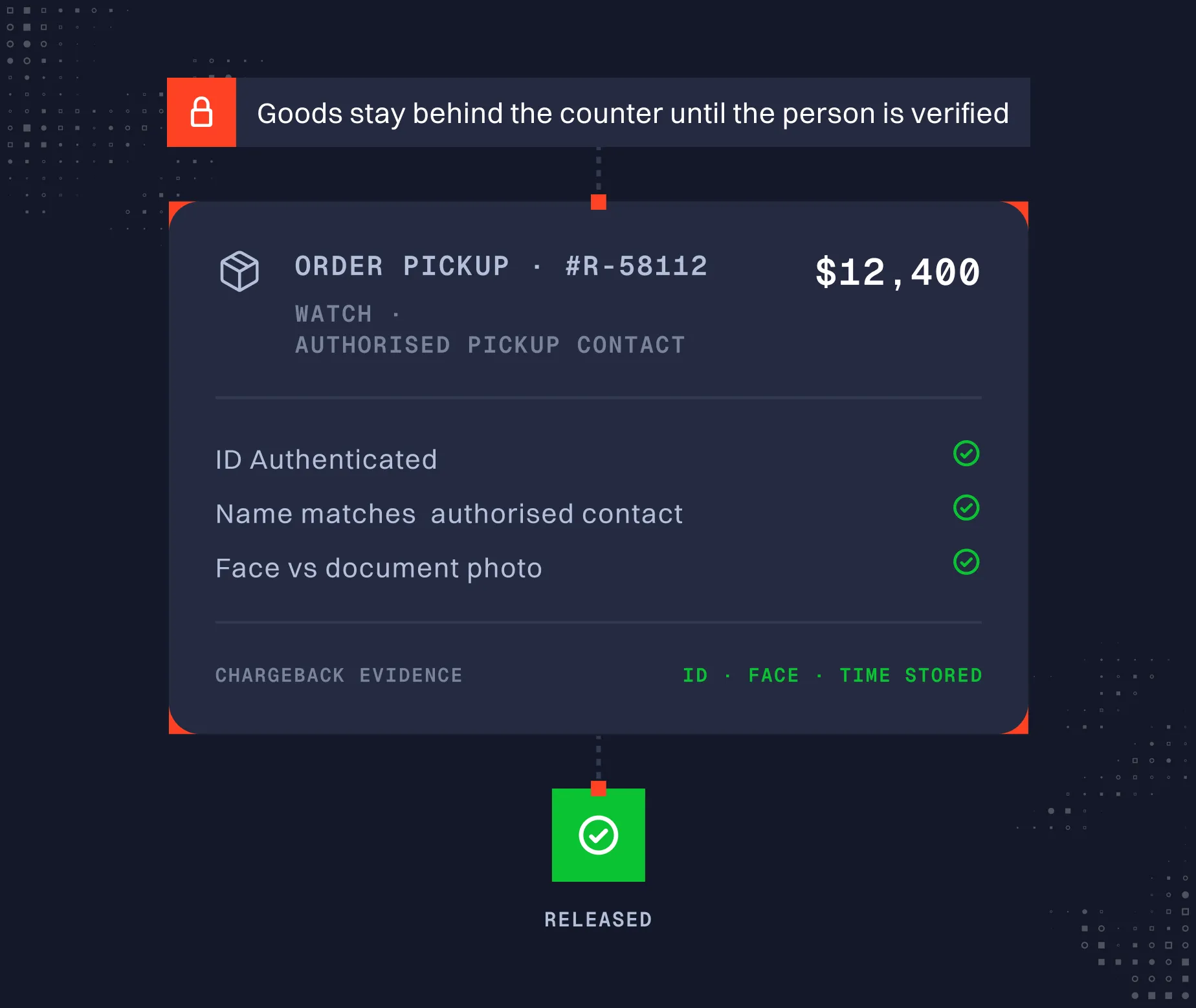
Stop counterfeits and fraudsters before high-value merchandise or credit leaves the store, and keep a defensible record of every check.
.svg)
Financing, credit & account opening
Authenticate the applicant's physical identity before a financing application, store card, or account proceeds, so credit doesn't open on a stolen or fabricated identity with no intent to repay.


High-value purchase & merchandise release
Confirm the identity before releasing high-value goods to the buyer or authorized pickup contact, on transactions that are hard to reverse.
.svg)
Regulated buying & cash reporting
Authenticate the seller's ID when buying gold, jewelry, or watches from the public, and capture verified identity for cash sales that must be reported.
.svg)
Returns, exchanges & service release
Verify the person before releasing repaired, exchanged, or returned high-value goods across the counter.

Multi-store standardization
Run one identity process across every store, boutique, service desk, and pickup point instead of relying on local judgment.
.svg)
Purchase-limit enforcement
Authenticate the buyer's ID at purchase and recognize the same person across locations, so straw buyers and resellers can't bypass allocation limits.
.webp)
.webp)
.webp)
.webp)
.webp)

The ROI goes beyond the access you deny
Direct losses drop: Fewer losses on fraudulent purchases, pickups, and financing.
Risk exposure drops: Fewer policy gaps, weak dispute records, and missed internal-list matches.
Customer experience improves: Faster transactions and less counter friction for real customers.

Why security, compliance, and IT teams say yes
Keep data behind your firewall
Documents and identity data stay in your environment, so you meet compliance and governance policies.
Integrates with existing systems
Connects with POS, CRM, clienteling, finance, loss-prevention, and case-management systems.
Keep an audit-ready record
Maintain a complete trail of every identity check for chargebacks, disputes, investigations, and cash-reporting.
Recognized by the bodies that set the standards












What is identity verification for high-value retail?
It's confirming, at the point of sale, that a customer's physical ID is genuine and that the person presenting it is its rightful holder, before high-value goods, credit, or a customer record depend on it.
How does Veridocs prevent fraud in jewelry and luxury stores?
Identity verification at a bank confirms two things in person: that the ID presented is a genuine government document, and that the person presenting it is its rightful holder. It's the first control at the branch, and the one that account opening, KYC, and AML checks all depend on.
Can it detect counterfeit or fake IDs?
Identity verification at a bank confirms two things in person: that the ID presented is a genuine government document, and that the person presenting it is its rightful holder. It's the first control at the branch, and the one that account opening, KYC, and AML checks all depend on.
How does it help with high-value transactions and financing?
Identity verification at a bank confirms two things in person: that the ID presented is a genuine government document, and that the person presenting it is its rightful holder. It's the first control at the branch, and the one that account opening, KYC, and AML checks all depend on.
Does it screen customers against watch lists?
Identity verification at a bank confirms two things in person: that the ID presented is a genuine government document, and that the person presenting it is its rightful holder. It's the first control at the branch, and the one that account opening, KYC, and AML checks all depend on.
Will it slow down real customers?
Identity verification at a bank confirms two things in person: that the ID presented is a genuine government document, and that the person presenting it is its rightful holder. It's the first control at the branch, and the one that account opening, KYC, and AML checks all depend on.
How is this different from a barcode scanner or a UV light?
Identity verification at a bank confirms two things in person: that the ID presented is a genuine government document, and that the person presenting it is its rightful holder. It's the first control at the branch, and the one that account opening, KYC, and AML checks all depend on.
Don't let a fake ID become a fraudulent sale. Be Certain.